By Josh LEE
The complex interplay of mechanical, environmental, and operational factors makes managing the safety and reliability of railway wagons over long distances difficult with traditional manual and mathematical systems and methods. Increasing freight volumes, longer trains, and higher speeds further amplify these risks.
Mechanical failures and track-related incidents pose major hazards, leading to derailments and operational delays. Reliable rail operations are essential to minimizing downtime and maintenance costs while optimizing fuel and energy use. At the same time, rail operators must comply with stringent safety regulations and sustainability standards imposed by global rail authorities.
Current physical testing and validation methods are labor-intensive and expensive. Manual mathematical computations often lack the precision needed for complex simulations. Additionally, in-house tools developed by engineering teams rarely match the sophistication of specialized industrial simulation software.
SIMULIA Simpack: Optimizing rail freight performance for safety
Dassault Systèmes’ SIMULIA Simpack uses virtual twin technologies and data-driven simulations on the 3DEXPERIENCE platform to enhance rail freight safety, reliability, and efficiency. Simpack helps engineers to conduct multibody system simulations (MBS) covering derailment prevention, wheel wear analysis, structural fatigue assessments, and braking optimizations. By leveraging advanced simulation technologies, rail operators can create more sustainable and resilient rail operation systems.
Simpack’s simulation-based approach helps engineers analyze and improve crucial operational aspects before real-world implementation.
Simpack models complete rail vehicle systems, incorporating interactions between wheel-rail contact, suspension dynamics, bogie performance, and external environmental factors.
With Simpack, rail operators can:
- Analyze rail vehicle dynamics to predict operational behavior.
- Optimize suspension and wheel-rail interaction to reduce wear and improve efficiency.
- Simulate and manage extreme conditions to enhance rail system resilience.
Five ways SIMULIA Simpack impacts rail freight safety
1. Derailment prevention through roll-over analysis
Preventing derailments, particularly when maneuvering curves at different speeds, is critical for train stability. Simpack enables engineers to conduct roll-over analyses using CAD geometry, train models, bogie excitations, and track geometry as inputs. Analysts can generate a Design of Experiments (DOE) sequence to test different intermodal car configurations navigating curves.
The Simpack Solver runs simulations with various derailment coefficients and wheel raise alignments to determine the velocity thresholds at which derailment might occur. Engineers can then optimize train arrangements, braking mechanisms, and weight distribution to mitigate risks.
The 3DEXPERIENCE platform’s and virtual twin technology enables operators to foresee and address potential hazards before they arise, ensuring safe and uninterrupted rail operations.
In addition, virtual homologation tests on the 3DEXPERIENCE platform — aligned with European Standard EN 14363 — simulate derailment risks to ensure compliance with international safety guidelines. Simulations can reveal whether improperly balanced intermodal cars exhibit a higher likelihood of derailment, prompting necessary adjustments to loading protocols.
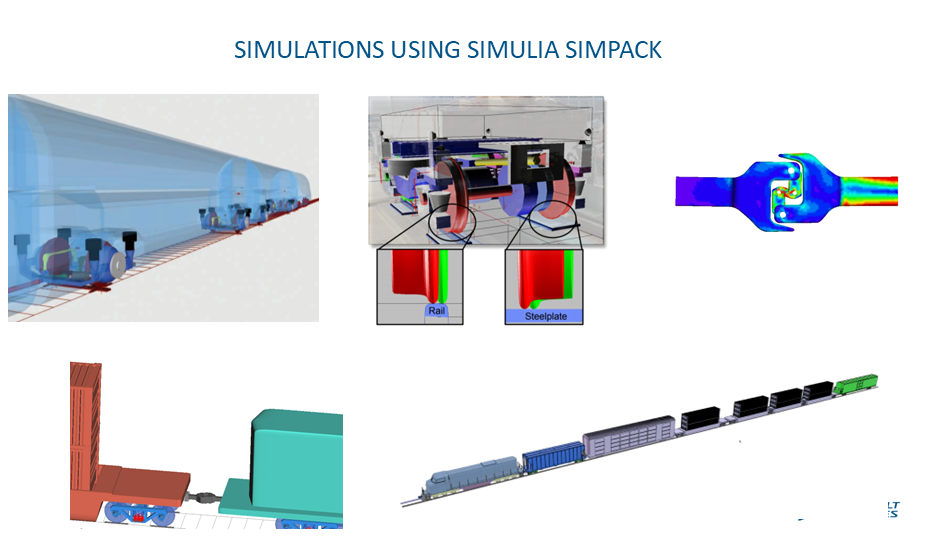
2. Wheel-rail interaction and wear analysis
Wheel wear directly impacts maintenance costs and rail safety. Using Simpack, engineers can simulate various rail profiles and wheel geometries to develop optimal designs that extend service life and reduce maintenance needs.
Operators can also assess wear rates and damage accumulation under different load conditions. If wear analysis reveals significant variations in wear patterns, it indicates the need for optimized track and wheel interactions.
By integrating train geometry and freight models, engineers can design new wheel profiles and incorporate them into freight simulations. Simpack allows users to model track and velocity conditions to compute inter-coupler forces and analyze force limits for safety in accordance with EN 15839. Freight vehicle dynamics simulations refine train configurations to minimize track wear and rolling resistance.
Advanced computational models integrate wheel wear with fatigue analysis, improving failure prediction and long-term safety.
3. Structural fatigue and life and damage assessment
Rail vehicle components experience continuous loading and dynamic stresses, leading to fatigue-related failures over time. Simpack, integrated with fail-safe solvers, enables engineers to conduct life-damage analysis, estimating stress accumulation and predicting the remaining lifespan of inter-coupler systems and bogie structures.
Simulations highlight critical failure points in inter-coupler components, prompting the need for improved material choices and stress distribution strategies. Predictive maintenance, guided by stress analysis data, helps engineers to take corrective action before failures occur — enhancing rail safety and long-term reliability. Real-time stress tracking within CAD models reduces unforeseen failures and maintenance downtime.
4. Braking system optimization
Efficient braking is crucial for both safety and operational efficiency. Simpack simulates various braking conditions, including emergency stops and downhill gradients, to analyse braking performance. It evaluates different braking systems — such as disc brakes and regenerative braking — to determine optimal braking strategies that minimize wear and improve response times.
Simulations incorporate braking forces as excitations applied to train models to assess safety and efficiency. Emergency braking analyses ensure compliance with EN 15839 safety standards, preventing excessive longitudinal forces that could lead to jack-knifing incidents. Scenario models can integrate dynamic braking force distributions, reducing abrupt deceleration effects and wear on braking systems.
Real-world applications: Success stories
Several leading rail operators and manufacturers have successfully implemented Simpack to enhance safety and reliability:
- European rail freight operator: Simpack helps analyze bogie performance under high-speed conditions, resulting in an 18% reduction in maintenance costs.
- North American freight carrier: Derailment prediction models on Simpack reduced derailment incidents by 25 percent.
- Asian rolling stock manufacturer: Optimized suspension systems with Simpack enhanced ride comfort and stability in heavy-load scenarios
How SIMULIA Simpack delivers value to rail operators
Simpack optimizes rail system performance for safety, reliability, and cost-efficiency, helping operators build safer and more resilient freight networks. The software delivers value to stakeholders in the following ways.
- Cost Savings: Predictive maintenance reduces unexpected failures, potentially saving millions in repairs and downtime.
- Enhanced Safety: Advanced modeling helps mitigate risks before they occur.
- Regulatory compliance: Simulations ensure adherence to global safety and performance standards.
- Fewer physical trials: Virtual homologation testing reduces costly physical trials, expediting certification.
- Safety for high-frequency corridors: Track wear simulations improve safety on heavily trafficked freight routes.
Proactive maintenance with AI and virtual twin integration
As rail freight operations become more complex and high risk, SIMULIA Simpack’s AI and virtual twin technologies become essential to driving predictive analytics and automation for proactive maintenance. With these advancements, you can enable real-time monitoring and significantly improve fault detection in on-going operations.
Virtual twins provide an exact virtual representation of physical trains, optimizing fault detection and repair efficiency.
AI-driven simulations on the 3DEXPERIENCE platform refine predictive maintenance strategies, while critical speed analysis using virtual twins helps prevent derailments by minimizing oscillations and excessive lateral motion.
The data-driven approach to proactive maintenance by Dassault Systèmes’ SIMULIA Simpack, which strengthens safety from track technologies to maintenance workflows, is key to improving accident prevention and enforcing regulatory compliance efforts across the entire spectrum of rail operations.